Death
As Natural and Generative
at All Levels of Reality
by Connie Barlow & Michael Dowd
www.TheGreatStory.org/charts/death.html
revised June 2005
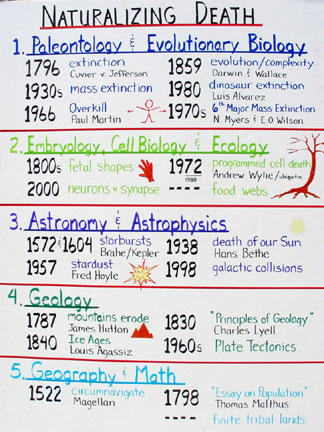

PALEONTOLOGY - Not until 1796 did scientists begin to entertain the idea that species and whole types of life have gone extinct in Earth history. In 1796 the French anatomist Georges Cuvier shocked the world by pronouncing that huge teeth (now known to be mammoths and mastodons) were distinct from those of living elephants and that these creatures were no longer to be found alive on Earth. In the United States, our president, Thomas Jefferson (a well-respected naturalist) protested, and launched the Lewis and Clark expedition in 1804, in part, to prove Cuvier wrong: to scout for living mammoths in the unexplored West. A decade earlier, Jefferson had included "mammoth" in his list of American mammals. He wrote,
"It may be asked why I insert the Mammoth [into a list of American mammals] as it it still existed? I ask in return, why I should omit it, as if it did not exist? Such is the economy of nature, that no instance can be produced of her having permitted any one race of her animals to become extinct, of her having formed any link in her great work so weak as to be broken."
As the decades rolled on and more fossils were discovered and compared with living forms, extinction became an accepted scientific fact. In 1841 the anatomist Richard Owen published a paper declaring that the strange fossil bones of giant creatures (which he called "dinosaurs") were all that remained of huge land animals with a combination of bird and reptile characteristics that had gone extinct. In 1858 the former existence of these huge animals became indisputable, when an almost entire skeleton of an adult duckbilled dinosaur (Hadrosaurus) was unearthed in New Jersey USA.
That same year Alfred Russel Wallace and Charles Darwin announced to the world a plausible process by which evolutionary shifts in lineages of life could have occurred naturally. The following year, Darwin published his landmark On the Origin of Species (1859). There Darwin wrote wrote,
"No one I think can have marvelled more at the extinction of species, than I have done. When I found in La Plata the tooth of a horse embedded with the remains of Mastodon, Megatherium, Toxodon, and other extinct monsters, which all co-existed with still living shells at a very late geological period, I was filled with astonishment; for seeing that the horse, since its introduction by the Spaniards into South America, has run wild over the whole country and has increased in numbers at an unparalleled rate, I asked myself what could so recently have exterminated the former horse under conditions of life apparently so favourable. But how utterly groundless was my astonishment! Professor Owen soon perceived that the tooth, though so like that of the existing horse, belonged to an extinct species."
Darwin continued,
"In the oldest tertiary beds a few living shells may still be found in the midst of a multitude of extinct forms. Falconer has given a striking instance of a similar fact, in an existing crocodile associated with many strange and lost mammals and reptiles in the sub-Himalayan deposits. The Silurian Lingula differs but little from the living species of this genus; whereas most of the other Silurian Molluscs and all the Crustaceans have changed greatly."
Nonetheless, Darwin (wrongly) resisted the idea that the stark demarcations in the fossil record (for example, that which had inspired earlier geologists to delineate Cenozoic rocks from earlier Mesozoic rocks, the "K/T boundary") represented equally stark die-backs in the actual living world. Rather, he considered such geological boundaries as artifacts of Earth's cycles of erosion and deposition:
"On the theory of natural selection the extinction of old forms and the production of new and improved forms are intimately connected together. The old notion of all the inhabitants of the earth having been swept away at successive periods by catastrophes [as in Noah's Flood], is very generally given up, even by those geologists, as Elie de Beaumont, Murchison, Barrande, &c., whose general views would naturally lead them to this conclusion. On the contrary, we have every reason to believe, from the study of the tertiary formations, that species and groups of species gradually disappear, one after another, first from one spot, then from another, and finally from the world. Both single species and whole groups of species last for very unequal periods; some groups, as we have seen, having endured from the earliest known dawn of life to the present day; some having disappeared before the close of the palaeozoic period. No fixed law seems to determine the length of time during which any single species or any single genus endures. There is reason to believe that the complete extinction of the species of a group is generally a slower process than their production."
Thus, the idea of mass extinction was strongly resisted by Darwin and by most evolutionary scientists that would follow him, even into the 1930s. Gradually, over the course of decades in the mid 20th century, mass extinction was accepted as fact. Then, in the late 1970s, Norman Myers shocked the world by proclaiming that humans are now causing the Sixth Major Mass Extinction. And beginning in the 1960s, but becoming the dominant thought in the 1990s, Pleistocene ecologist Paul Martin led the way in demonstrating, place by place, episode by episode, that humans armed with projectiles and fire effected "overkill" of megafauna on continents and flightless birds and large reptiles on islands whenever our species moved into a new landscape of creatures that did not co-evolve slowly with our technology, thus implicating even pre-agricultural humans, beginning 40,000 years ago in Australia, in this mass extinction of our own making.
Results:
Species and entire forms of life have gone extinct.
There have been five major mass extinctions, and humans are causing the sixth.
Even pre-industrial humans are implicated in the Sixth Major Mass Extinction.
EVOLUTIONARY BIOLOGY - As Loren Eiseley has written (1962, "The Firmament of Time") in order for evolution to be discovered, first scientists would have to discover that species death was natural and pervasive in Earth history. Thus, Charles Darwin in 1859 was able to launch the idea of biological evolution in his "On the Origin of Species." But Darwin did not then know of mass extinction, which would gradually come to be accepted only in the mid 20th century. Here is a quote from Loren Eisleley's essay, "How Death Became Natural":
"It is necessary in surveying the human quest for certainty to consider death before life. I have not done this out of perversity. Rather I have done it because, in the sequence of ideas we have been studying, it is necessary to understand certain aspects of death before we can comprehend the nature of life and its changes. Man, even primitive man, has tended to take life for granted. Death was the unnatural thing, the result of malice or mistake, the after-thought of the gods, or, in the Christian world, the result of the Fall from the Garden. In the development of a scientific approach to life on this planet, therefore, the recognition of death - species death, phylogenetic death - had to precede the rise of serious evolutionary thought. For without the knowledge of extinction in the past, it is impossible to entertain ideas of drastic organic change going on in the present or future."
Results:
Evolution of complex life depends on differential death; for life to be seen as natural, death must first be naturalized.
Death is natural and generative for the richness of life.
"Death, it brings good things to life." — Tom Atlee, 1990
EMBRYOLOGY - [dates and names need to be inserted]. As the plant or animal embryo develops, death is crucial in order for the differentiation of tissues and organs and to produce the overall form and shape of the organism. Without the death of fetal cells, there could be no hand or foot, no fin or wing, no root or branch. Without the death of fetal cells, life would be spherical.
Results:
Without the death of fetal cells, all life would be spherical.
Death is natural and generative for diverse shapes of life.
CELL BIOLOGY - In 1972 Andrew Wyllie discovered and named the phenomenon of programmed cell death whereby cells are made to terminate their life and growth within even the adult organism, not just the growing fetus. When cells fail to terminate, cancer may be the result. In 2005 three scientists were awarded the Nobel Prize in Chemistry for their discovery in 1980 of "the kiss of death molecule". They called this protein molecule "ubiquitin"; when a worn-out protein molecule needs to be recyled for its materials, from which new proteins can be formed, the cell attaches ubiquitin to it, which is then a signal for that protein to be moved to the proteasome, the recylcing center of the cell.
Finally, around the turn of the 21st century, various scientists learned that the death of neurons inside the brain, beginning within the fetus and continuing into adulthood results in more than half of the original neurons dying off, such that abundance of neurons is replaced by increases in the number of synaptic connections, which is crucial for making sense of the world.
Results:
When cells rebel against death, the result is cancer.
Cellular death is a partner in maintaining bodily health and mental development.
"A cancerous tumor is born when one batch of cells no longer cooperates with others. By dividing endlessly, or by failing to die properly, these cells can destroy the necessary balance that makes a living, individual person. Cancers break the rules that allow cells to cooperate with one another. Like bullies who break down highly cooperative societies, cancers behave in their own best interest, until they kill their larger community: the human body." — Neil Shubin, Your Inner Fish, 2008
BOTANY - Botanists have long understood that the living cells of trees are found above ground mostly in the leaves, and in just a very thin layer that separtes bark from inner wood. As the cells within that thin layer die and are replaced by fresh cells, the dead cells are filled with lignin, and the outer ones become bark, the inner become wood.
Results:
Without the death and retention of plant cells, there would be no structural support for trees.
ASTRONOMY & ASTROPHYSICS - In 1572 and again in 1604, supernova stars (an absence of parallax demonstrated they were far into the heavens, not closer than the moon) shocked Europeans into realizing that the heavens are not immutable, thus supporting the work of Copernicus and (later) Galileo. In 1938, Hans Bethe discerned the life cycles of stars and concluded that our own star, the sun, likewise will turn into a Red Giant (incinerating Earth at that time) and, later, die when its stores of primordial hydrogen have all been consumed. In 1957, Fred Hoyle and 3 colleagues published a landmark paper revealing the processes by which stars create all the chemical elements (other than hydrogen). This process is called stellar nucleosynthesis, the knowledge of which gave birth to the insight that "We are recycled stardust!". Since then, scientists have learned that many galaxies have been consumed by larger galaxies or merged, that our own Milky Way will interact dramatically with the approaching Andromeda Galaxy in about 2 billion years, and that massive black holes not only consume matter but perhaps may birth new universes in the process.
Results:
Without the death of stars there could be no planets or life.
Our sun will die; galaxies merge; black holes are mysterious agents of massive death and possible rebirth.
Death is natural and generative throughout the cosmos.
GEOLOGY - In 1787 James Hutton published "The Theory of Earth," which presented the new science of geology, and which characterized the surface of Earth as undergoing great changes; henceforth, even mountains were not immortal. From 1830 to 1833, Charles Lyell (Scottish) published his 3-volume "The Principles of Geology," which furthered the paradigm shift initiated by Hutton. In 1840, Louis Agassiz (French) published "Studies on Glaciers," which demonstrated that much of Europe (and Canada/US) had once been covered by glacial ice, the soil swept away. The melting ice sheets deposited new rocks, from the size of boulders to glacial silt, on which life would nurture new soils. We now know, too, that the abundance of lakes in the north owes to the workings of glaciers, and that lakes are not immortal (these too will vanish, unless renewed by glaciers). Finally, in the 1960s various scientists ushered in the new plate tectonics paradigm (whose radical precursor was the much-maligned "theory of continental drift" proposed by Alfred Wegener in the 1930s). Now we learned that even continents (Pangaea) and seas (the Tethys Sea) vanish, and that new configurations of land (North America) and seas (the Atlantic Ocean) are born. [For a science perspective on the life-promoting aspects of deadly earthquakes, such as the one that caused the huge tsunami in the Indian Ocean in December 2004, click Deadly and Yet Necessary, Quakes Renew the Planet, by William J. Broad, published in The New York Times (1/11/05)].
Results:
Mountains erode away; glaciers raze and then refresh the landscape; continents are torn asunder; seaways ebb and grow.
Death is natural and generative for land and sea.
GEOGRAPHY & MATH - In 1522 the remaining crew of the voyage begun by Ferdinand Magellan (Portuguese) circumnavigated the planet by sailship, proving Earth to be finite. In 1798 Thomas Malthus alerted the western world to the problem of unchecked human population growth in a finite world.
Results:
Earth and its resources are finite.
Death of elders is necessary in order for Earth to have children. If humans were earthly immortals, very soon the birth of children would have to cease.
Click here to access PROGRAMS, RESPONSIVE READINGS, AND SONGS that celebrate a deep-time understanding of death.
RETURN TO DEATH PROGRAMS.
RETURN TO GREAT STORY HOME PAGE.