|
2023 Update: Michael Dowd's Death
 |
|
• 2023 VIDEO ON YOUTUBE (5 minutes)
Given that Connie learned of her husband's death by the knock of a police officer at her door, Day 1 of being a widow was really tough. But by Day 3, she had found solace and a unusual sense of aliveness by using her geek skills to strengthen Michael's legacy presence online. She produced this video on Day 5.
Do read the full caption to this video, as this is where she reports the basic facts of his sudden death by heart attack and summarizes the topical shifts in his speaking and writing career of three decades.
(The comments posted on the video page are extraordinary; so do look at those, too.)
|
• Commemorating the first anniversary of Michael Dowd's death, Gerry Russell and Sister Gail Worcelo led a ceremony at Green Mountain Monastery, Vermont, spreading a large portion of his ashes at the boulder marking the grave of Thomas Berry. A 24-minute VIDEO of the ceremony was created by Gerry Russell, with music added.
Michael Dowd Sermons and Interviews on Death
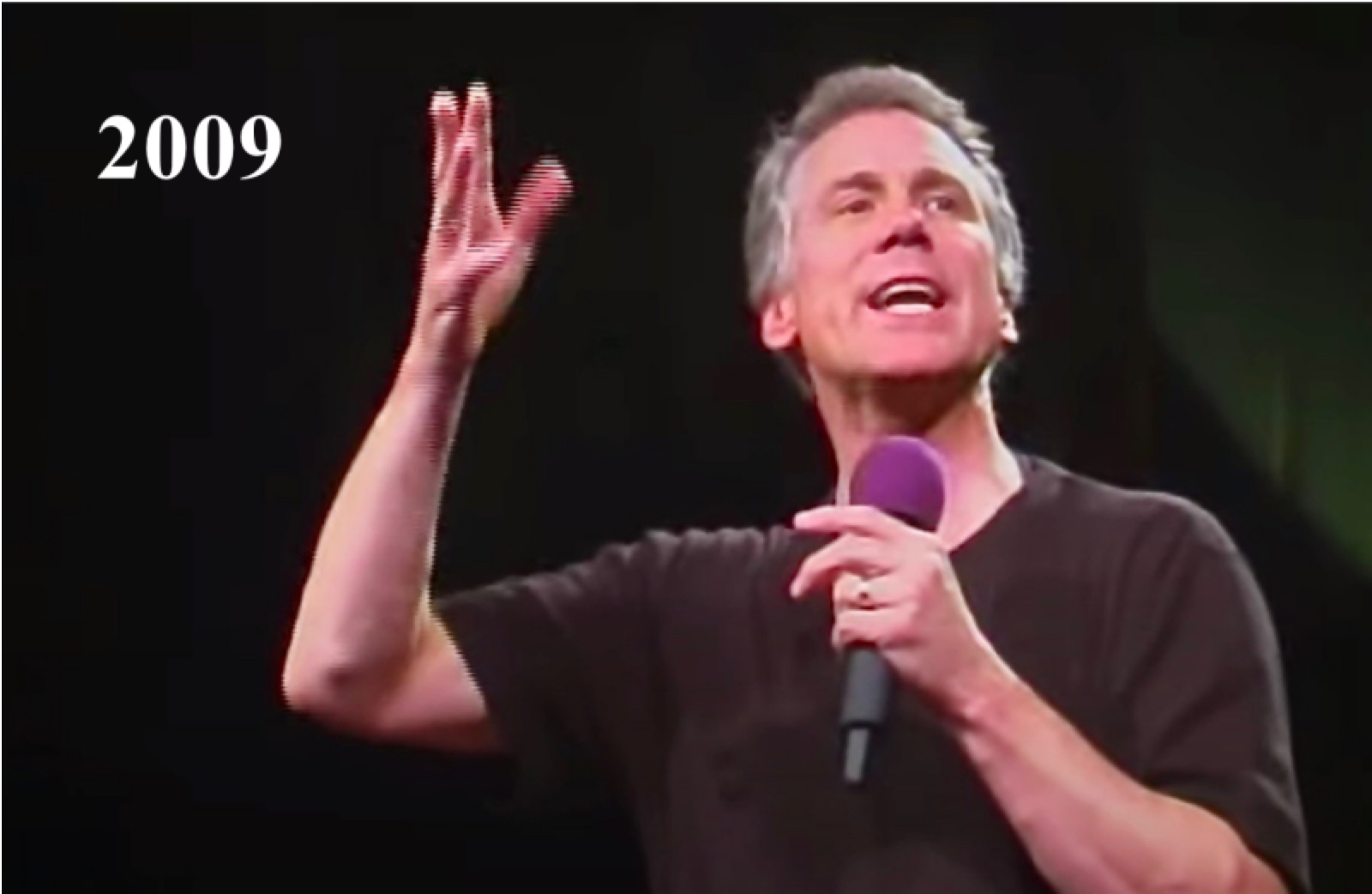
• "Death: No Less Sacred Than Life" (4 minutes; 2009)
 |
|
Michael shed his evangelical form of Christianity when Thomas Berry became his mentor in 1988. Scriptural literalism was gone — but not the religious fervor.
Rarely did Michael have an opportunity to preach full-out in a pentecostal style after he made that worldview shift. The video at left is a high point. In 2009 he delivered the Wednesday evening sermon at a New Thought megachurch in California. Three cameras captured this 35-minute dynamic sernon.
Linked here is just the 4-MINUTE section on Death: No Less Sacred Than Life.
|
 |
|
• 2024 VIDEO ON YOUTUBE (51 minutes)
To honor the first anniversary of Michael's death, his widow (Connie Barlow) assembled video excerpts of three of Michael's sermons on the topic of death that he had delivered during the couple's 18 years of itinerant ministry throughout the USA and Canada. The 3 exerpted sermons are:
• 2015 at People's Church of Ludington, MI
• 2018 at Unity of Houston, TX
• 2023 at Unitarian Universalist Congregation of Flint, MI
|
 |
|
• 2023 VIDEO ON YOUTUBE (30 minutes)
This was Michael's final sermon — and many of us regard it as his best. He died less than two months after this appearance at the Unitarian Universalist Congregation of Flint, Michigan. Eerily, this sermon brought the topic of death into the foreground. As it was point 2 of a 3-point message:
1. Nurture intimacy with Life
2. Honor your & our mortality
3. Attend to what matters most
Connie says this was not a tragic death. Michael's life was complete. She knows he says, "Amen!"
|
 |
|
• 2023 VIDEO ON YOUTUBE (35 minutes)
February 2023, Duane Kuss had a personal conversation with Michael about death. Eight months later, Dowd dies suddenly of a heart attack.
Duane decided to edit the original video to highlight Michael's comments and wisdom and then post it on his youtube channel. Michael's widow, Connie Barlow, agreed.
QUOTE: "An expanded sense of identity both in time and in space fundamentally informs everything for me."
|
 |
|
• 2022 VIDEO (37 minutes; 2022)
Winter Solstice 2023, David Baum (Collapse Club) asks, given all the bad news, what can we celebrate?
Michael responds, "If you really understand our predicament, the question isn't what can we celebrate. It's like, what the hell would I not celebrate?!"
Michael thus turns the conversation into how COLLAPSE acceptance, coupled with one's individual DEATH acceptance, can evoke a prevailing sense of gratitude for the simple blessings of life.
|
 |
|
• 2018 VIDEO ON YOUTUBE (18 minutes)
Upon hearing of Michael's death, Dean Spillane-Walker posted on his youtube channel the "Death" section of an 8-part video series by Living the Questions. That series was based on video captured in November 2018, while Michael was speaking to a large audience at St. Paul's United Methodist Church in Houston, Texas.
The full video program is titled, "ProFuture Faith: The Prodigal Species Comes Home". A dvd version is available for purchase from the Christian educational organization that filmed and edited it: Living the Questions.
|
 |
|
• 2015 VIDEO ON YOUTUBE (28 minutes)
Guest sermon delivered 2015 at People's Church of Ludington, MI. This is Michael's fullest and most personal rendition of "Death as natural and necessary and no less sacred than life". Following, he leads the congregation in a recitation of a litany written by Connie, "The Gifts of Death."
Key references to the wisdom of others (with image overlays) include William R. Catton, Paul Kingsnorth ("Dark Mountain Manifesto") and John Michael Greer. Audios Michael recorded of all three authors are posted on his Soundcloud page - "Michael Dowd: RIP Homo colossus", with table of contents here.
|
More Programs on Death by Connie Barlow and Michael Dowd

|
|
Although Connie wrote this as a CHILDREN's story Spring of 2009, it is also very suitable (and poignant) for oral delivery with adults. Fall of 2009, Michael was ill in bed following his 4th chemo treatment for cancer. So she asked him to play the interactive role of the child, while she AUDIO-RECORDED the reading.
August 2024, 10 months after Michael's death, Connie listened again to that old audio recording. She was inspired to turn it into a 54-minute VIDEO, with text and image overlays. |
Biographical Note: The author attributes her own excellent capacity to visualize words and create imaginary scenes to the practice of her father, who extemporaneously created a bedtime story every night for her and her sister — never using a picture book — and who often asked his daughters to participate in choosing characters and other elements as the story emerged. Connie's father died a few days before her 14th birthday, and she still remembers the multiple-episode story that had been ongoing up to the day of his sudden and unexpected death. Death has since become a crucial aspect of her spiritual path. (Remarkably, her husband died in 2023 from the exact same type of sudden and massive heart attack.)
 |
|
• 2020 VIDEO ON YOUTUBE (52 minutes)
This video was produced in the the second month of the covid crisis in the USA. Connie had written her own "Covid Legacy Pledge" to supplement her living will. Here she grounds her pledge to forego hospital interventions re covid on a depth understanding of how pervasive and natural death was for her immigrant maternal grandparents — and how her mother spoke of that experience and her own sense of generational justice as core for her own in-home choice of dying.
The final 24-minutes is an excerpt of a 2011 video that she and Michael Dowd partnered: "Death, Budgets, and Generational Justice. Part 1 of this legacy pledge video pair is 33 minutes. |
Perhaps there is no more alluring portal for experiencing the benefits of evolutionary spirituality — that is, a spirituality grounded in a modern, evolutionary cosmology — than by way of a profoundly new way of understanding death.
Thanks to the sciences of astronomy, astrophysics, chemistry, geology, paleontology, evolutionary biology, cell biology, embryology, ecology, geography, and math, we can now not only accept but celebrate that:
1. Death is natural and creative at every level of reality.
2. Death is no less sacred than life.
BEST SHORT SUMMARIES (2012 in Huffington Post): "Death: Sacred, Necessary, Real" and "A Scientific Honoring of Death"
BACKGROUND READING: "The Science that Grounds the New Understanding of Death"
It is vitally important to convey this full, comforting (indeed, inspiring!) view of death to all ages for this reason: In any society that still has a large segment of its population believing in the Bible literally, the default explanation for why there is death is drawn from Romans 5:12 (attributed to the writings of the Apostle Paul): "Wherefore as by one man sin entered the world, and death by sin; and so death passed upon all men." A (sadly) remarkable depiction of the story of how Adam and Eve brought death into the world is available oniine in cartoon format, as a short creationist tract.
Accordingly, absent another interpretation (such as the one offered here) all too often death is regarded as "the enemy." Until that cultural perception shifts, untold physical and emotional suffering (and financial cost) will likely continue unabated in modern hospitals — as many among us have experienced first-hand. See the July 15, 2011 piece by New York Times columnist David Brooks on this issue, titled "Death and Budgets". Brooks concludes his essay this way: "We think the budget mess is a squabble between partisans in Washington. But in large measure it's about our inability to face death and our willingness as a nation to spend whatever it takes to push it just slightly over the horizon."
See also...
"Death, Budgets, and Generational Justice", which is Connie Barlow's 2011 commentary on David Brooks' essay and a similar call to action by Daniel Callahan and Sherwin Nuland. AUDIO, or VIDEO.
Online Resources for Learning and Honoring Death
as Natural and Generative
 |
|
CHILDREN'S STORY: "Tree Talks About Death" This story by Connie Barlow weaves a mythic tale grounded in science through which the deep understandings of the creative role that death plays at all scales of the cosmos can be grasped by both head and heart, child or adult. Click here to listen to free online AUDIO of Connie reading aloud this story. |
 |
|
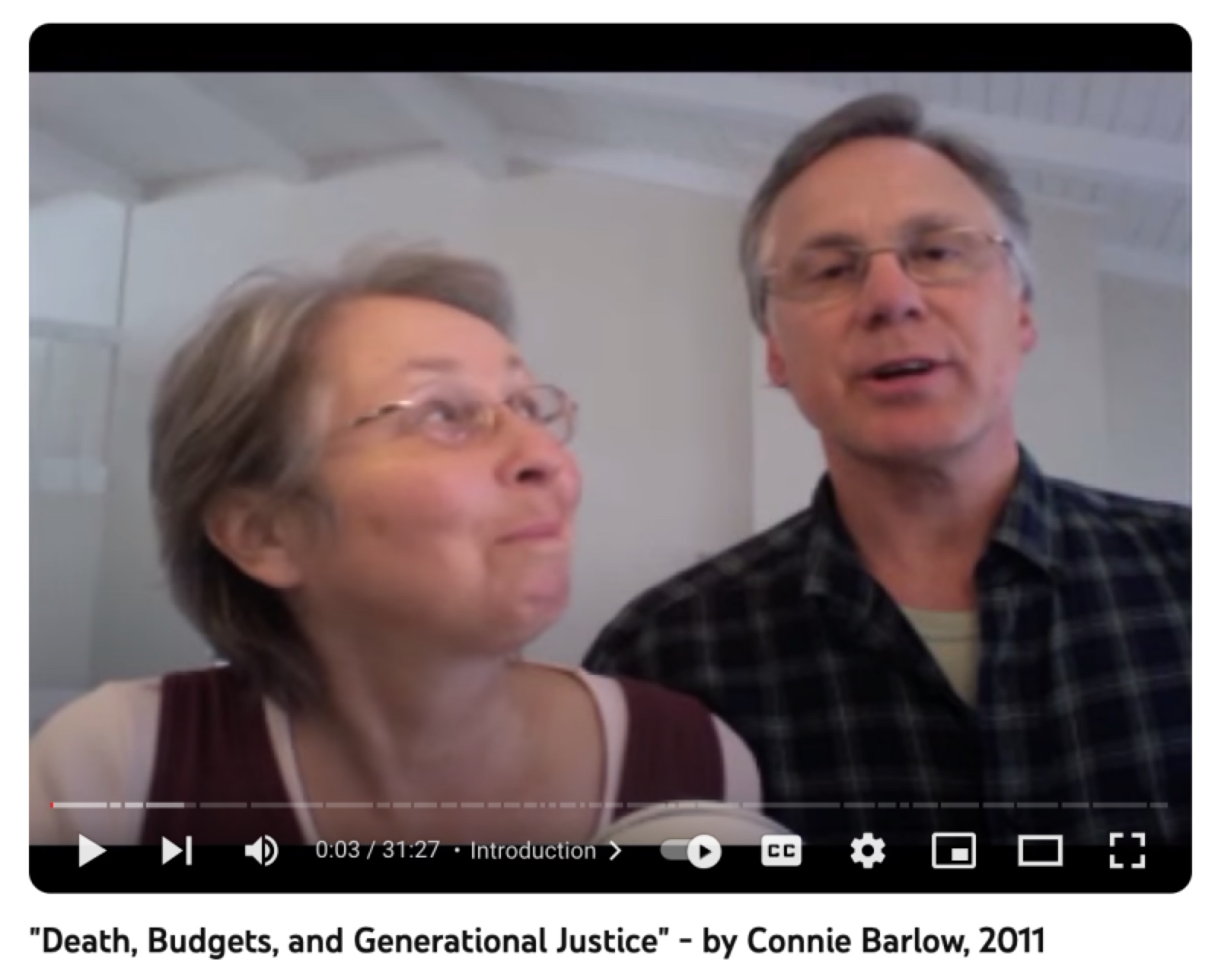
• 2011 VIDEO ON YOUTUBE (31 minutes)
Connie Barlow builds on the 2011 call-to-action opinion piece by NYT columnist David Brooks ("Death and Budgets"), and the 2011 essay (in The New Republic) by Daniel Callahan and Sherwin B. Nuland, "The Quagmire: How American Medicine Is Destroying Itself."
Here, Barlow issues her own call-to-action in order to "foment a revolution" with her fellow boomers. By "just saying no" to costly medical diagnostics and interventions that merely prolong dwindling life in our elder years, and by pioneering vibrant, responsible, and celebratory ways of openly and actively dying, we can return to humanity's ancestral roots of "generational generosity" in our modes of living and dying.
We each can take care to ensure that our legacy "passes forward" blessings to the generations who follow us — not insupportable debt.
|
AUDIO CONVERSATION: "When Death Gets Personal"
Half-hour audio conversation by Michael Dowd and Connie Barlow, recorded August 2009, as part of their newly launched "America's Evolutionary Evangelists" weekly podcast series.
AUDIO INTERVIEW: "It's All Really there!""
Barlow and Dowd interview Jon Cleland-Host for their podcast series, Inspiring Naturalism. In this episode, Jon Cleland-Host melds a reverence for his Native American heritage with a "deep-time" perspective born of modern science, thereby offering listeners a moving way to understand the fact of death and how death awareness adds vitality to one's experience of the present.
AUDIO: "Death Through Deep-Time Eyes" (half-hour sermon by Connie Barlow)
VIDEO: "Death Through Deep-Times Eyes"
excerpts from Connie Barlow's presentation in Ashland OR, 2009
Barlow A: "Time and Death" - 10 minutes
Barlow B: "Stardust and Death (pt 1 of 4)" - 8 minutes
Barlow C: "Stardust and Death (pt 2 of 4)" - 8 minutes
Barlow D: "Stardust and Death (pt 3 of 4)" - 7 minutes
Barlow E: "Stardust and Death (pt 4 of 4)" - 6 minutes
 |
|
• "Death Through Deep-Time Eyes"
in AUDIO, or VIDEO
April 2005, Connie Barlow presented the SONG and CHARTS version of her multi-year presentations on death. In later years in her death presentations she eliminated the song and switched from charts to powerpoint.
This earliest version has an immediacy and audience involvement that is diminished in the later, more "professional" versions of the same program.
37 minutes
|
 |
|
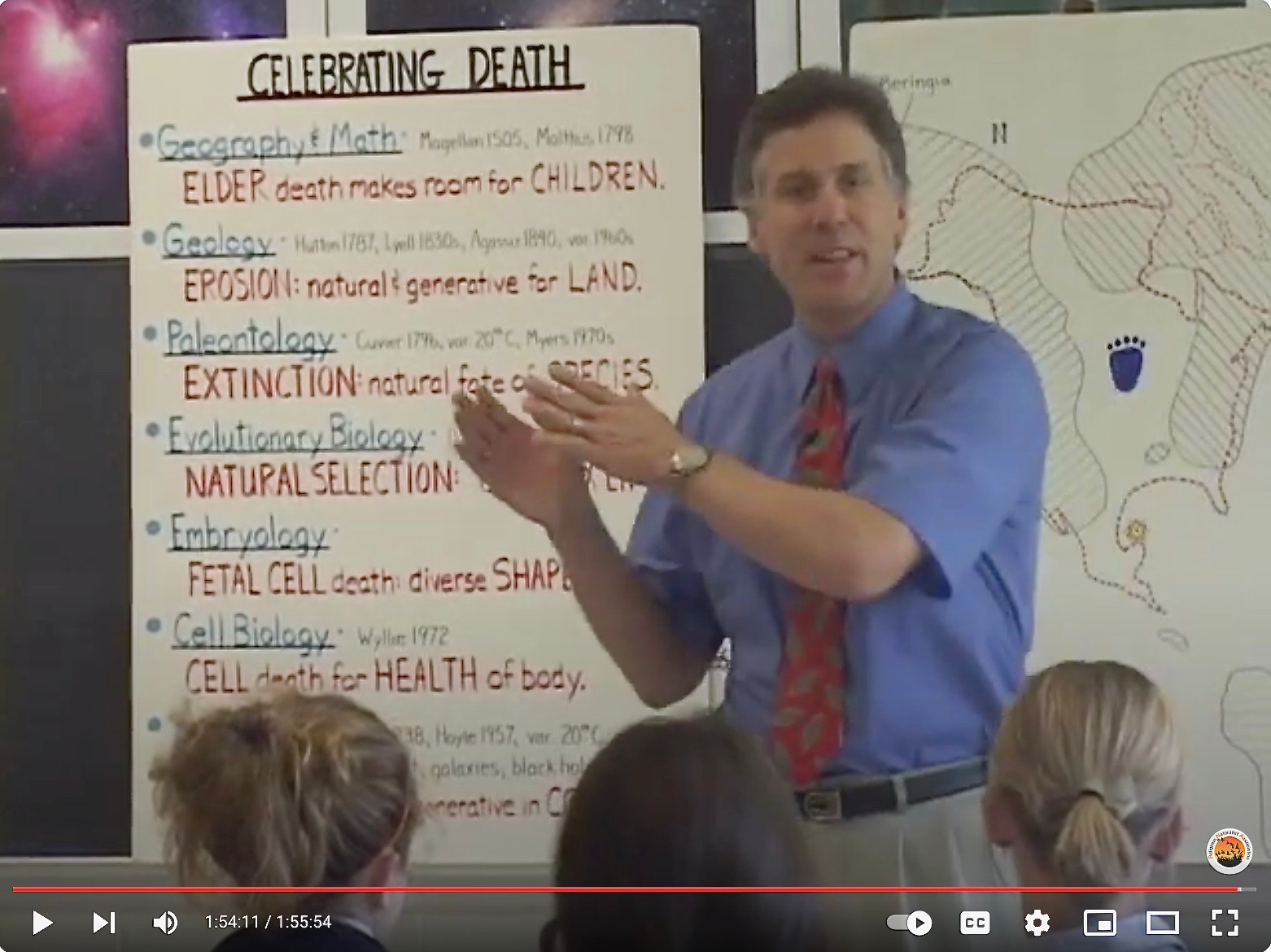
• Death section of "Evolutionary Christianity" talk at a Catholic High School
September 2004, Michael Dowd guest teaching at St. Ursula Academy in OHIO. This is a 20-minute section (begins at timecode 01:34:00) of his 2-hour presentation.
"Death is natural and generative at every level of reality."
|

|
|
LEFT: Rev. Marlin Lavanhar, at All Souls Unitarian Church in Tulsa, gives a moving week-after-Easter sermon about death and resurrection from a science-based perspective.
Beginning with a celebration that "we are made of stardust!", Rev. Lavanhar unfolds the wisdom of this new view within the challenges of life and the end of life. He calls this "the evolutionary version of the Easter story".
|
CURRICULUM: "Remember Who You Are: Living a Mythic Life"
12-week curriculum by Connie Barlow for assisting middle school youth in the life passage from childhood ("Explorers in the Garden") to early adolescence ("Thespians at the Oasis"), which uses the understandings drawn from the 2008 book by Bill Plotkin, Nature and the Human Soul, and using scene-by-scene the Disney movie The Lion King as a beloved bridge and focus for the middle school mindset. Understanding the naturalness of death of elders and of periodic psychological deaths as one transitions from one stage of life to the next is central to this curriculum.
HEALTH INSURANCE PROPOSAL: "Leaving a Legacy"
Connie Barlow's proposal for a new form of Group Health Insurance to serve individuals who share a philosophy that death is a natural part of life — not something to be battled irrespective of the emotional, physical, and financial costs.
STORY: "The Dance: An Evolutionary Parable Celebrating Death" by Larry Edwards, as published in EarthLight magazine.
MOVIE: "Griefwalker" - award-winning documentary on the work Stephen Jenkinson for naturalizing our understanding of and process of death (his personal website, including later books on death). See also many interviews of Jenkinson on youtube.
AUDIO STORY: "The Wishing Star" - online mp3 AUDIO of a terrific kids story on the naturalness of death of elders (on another website); written and read by Brenda Sutton, the 10 minute audio is described as, "a serious tale for older kids about life, death, and how to make a really important wish."
ARTICLE AND TED TALK VIDEO: "Death Over Dinner" conversational movement. Excerpt: On Aug. 24, 2013 Laura Sweet, a handful of friends, and hundreds of others in more than 250 cities will participate in Death over Dinner, coordinated meals hinged on connecting friends and strangers through conversations about life and death. They'll take place in churches, assisted living facilities, universities and homes in Florida, California, New York, Washington, India and Australia, among other settings. "We want to talk in an informal way about personal experiences with death. How do people want to die? Have you shared that with anyone? What deaths have you experienced?" said Sweet, a former tech website editor who recently transitioned into taking classes in end-of-life care and found the event via Twitter. "We don't want it to be distasteful, or uncomfortable, but an uplifting atmosphere."
ARTICLE: "Letting Go" - by Atul Gawande. This is perhaps the best article for experiencing the deep reluctance of patients and doctors to give up hope for a cure even in the most obviously of terminal situations. While the author does not take an evolutionary, deep-time perspective, readers here are recommended to consider that access to advanced medical intervention is a form of "supernormal stimulus." As with processed foods, recreational drugs, television, video gaming, and internet porn, our ancestors had no opportunity to evolve resistance to high-tech methods for extending the suffering and societal costs of the terminally ill. That is, even three generations back, humans never had an opportunity to develop addictions to any of these damaging possibilities taken to excess. Similarly, we have no deep instincts to say "no" when yet another costly and painful treatment is offered to us and especially our loved ones.
EXCERPT: "This is a modern tragedy, replayed millions of times over. When there is no way of knowing exactly how long our skeins will run — and when we imagine ourselves to have much more time than we do — our every impulse is to fight, to die with chemo in our veins or a tube in our throats or fresh sutures in our flesh. The fact that we may be shortening or worsening the time we have left hardly seems to register. We imagine that we can wait until the doctors tell us that there is nothing more they can do. But rarely is there nothing more that doctors can do. They can give toxic drugs of unknown efficacy, operate to try to remove part of the tumor, put in a feeding tube if a person can't eat: there's always something. We want these choices. We don't want anyone — certainly not bureaucrats or the marketplace — to limit them. But that doesn't mean we are eager to make the choices ourselves. Instead, most often, we make no choice at all. We fall back on the default, and the default is: Do Something. Is there any way out of this?"
ARTICLE: "A Life Worth Ending" - by Michael Wolff, in 20 May 2012 Atlantic Magazine.
EXCERPTS: Make no mistake, the purpose of long-term-care insurance is to help finance some of the greatest misery and suffering human beings have yet devised. . . That is the thing that you begin to terrifyingly appreciate: Dementia is not absence; it is not a non state; it actually could be a condition of more rather than less feeling, one that, with its lack of clarity and logic, must be a kind of constant nightmare.. . . "Old age," says one of Philip Roth's protagonists, "isn't a battle, it's a massacre." I'd add, it's a holocaust. Circumstances have conspired to rob the human person — a mass of humanity — of all hope and dignity and comfort.
I do not know how death panels ever got such a bad name. Perhaps they should have been called deliverance panels. What I would not do for a fair-minded body to whom I might plead for my mother's end.
The alternative is nuts: to look forward to paying trillions and to bankrupting the nation as well as our souls as we endure the suffering of our parents and our inability to help them get where they're going. The single greatest pressure on health care is the disproportionate resources devoted to the elderly, to not just the old, but to the old old, and yet no one says what all old children of old parents know: This is not just wrongheaded but steals the life from everyone involved.
And it seems all the more savage because there is such a simple fix: Give us the right to make provisions for when we want to go. Give families the ability to make a fair case of enough being enough, of the end's, de facto, having come. . .
Not long after visiting my insurance man those few weeks ago, I sent an 'eyes wide open' email to my children, all in their twenties, saying this was a decision, to buy long-term-care insurance or not, they should be in on: When push came to shove, my care would be their logistical and financial problem; they needed to think about what they wanted me to do and, too, what I wanted them to do. But none of them responded — I suppose it was that kind of email.
Anyway, after due consideration, I decided on my own that I plainly would never want what LTC insurance buys, and, too, that this would be a bad deal. My bet is that, even in America, even as screwed up as our health care is, we baby-boomers watching our parents' long and agonizing deaths won't do this to ourselves. We will surely, we must surely, find a better, cheaper, quicker, kinder way out. . .
Meanwhile, since, like my mother, I can't count on someone putting a pillow over my head, I'll be trying to work out the timing and details of a do-it-yourself exit strategy. As should we all.
ARTICLE: "End of Life, at Birth" - by April R. Dworetz, 4 August 2013, New York Times.
EXCERPTS: I am a neonatologist. I save babies. Most of them, especially those born after 28 weeks, will at most suffer mild or moderate disabilities. But of those born before 28 weeks — 30,000 of the half million babies born prematurely each year in this country — many will have serious physical, social, or cognitive problems.
A few months ago I cared for just such a child. Let's call her Miracle. She was born at 23 weeks' gestation and weighed a little over a pound. Despite the bleak prognosis, her parents asked that we resuscitate her in the delivery room. So we did. But over the next eight weeks, to keep her alive, we had to prick Miracle's heel so many times she developed scarring. We suctioned her trachea hundreds of times. We put tubes through her mouth and into her stomach, we stabbed her again and again to insert IVs, and we took blood from her and then transfused blood back. We gave her antibiotics for two severe infections.
Each of these events created suffering, for Miracle and her parents. Her mother visited daily and developed an anxiety disorder. Her father came in only once a week, the pain and sadness was so great. After eight weeks, Miracle came off the ventilator we had put her on. But three days later we had to turn it back on, and it was possible she would die or remain on the ventilator permanently if we didn't give her steroids, which can have side effects as serious as cerebral palsy. Her mother opted for the steroids. But Miracle's father was angry. He muttered to me: "Why do you do this? Why do you keep these babies alive?"
. . . we need to make sure both parents are always kept part of the discussion, to ensure we have their informed consent throughout treatment. It can't be just one conversation. . . Sometimes, I think we doctors need to do more than inform. On occasion, I've offered to make a life-or-death decision for parents. If they agree, they are essentially making the decision, but are shifting the burden to me. It's harder for parents to say, "I unplugged my baby," than to let the doctor do it.
ARTICLE: "The Importance of the Afterlife. Seriously." - by Samuel Scheffler, 21 September 2013, New York Times.
EXCERPTS: "I believe in life after death. My belief in life after death is more mundane. What I believe is that other people will continue to live after I myself have died. You probably make the same assumption in your own case. Although we know that humanity won't exist forever, most of us take it for granted that the human race will survive, at least for a while, after we ourselves are gone.
Because we take this belief for granted, we don't think much about its significance. Yet I think that this belief plays an extremely important role in our lives, quietly but critically shaping our values, commitments and sense of what is worth doing. Astonishing though it may seem, there are ways in which the continuing existence of other people after our deaths — even that of complete strangers — matters more to us than does our own survival and that of our loved ones.
. . . Of course, many people are terrified of dying. But even people who fear death (and even those who do not believe in a personal afterlife) remain confident of the value of their activities despite knowing that they will die someday. Thus there is a way in which the survival of other people after our deaths matters more to us than our own survival.
. . . The knowledge that we and everyone we know and love will someday die does not cause most of us to lose confidence in the value of our daily activities. But the knowledge that no new people would come into existence would make many of those things seem pointless. I think this shows that some widespread assumptions about human egoism are oversimplified at best. However self-interested or narcissistic we may be, our capacity to find purpose and value in our lives depends on what we expect to happen to others after our deaths.
. . . What is necessary to underwrite the perceived significance of what we do, it seems, is not a belief in the afterlife but rather a belief that humanity will survive, at least for a good long time.
But will humanity survive for a good long time? Although we normally assume that others will live on after we ourselves have died, we also know that there are serious threats to humanity's survival. Not all of these threats are human-made, but some of the most pressing certainly are, like those posed by climate change and nuclear proliferation. People who worry about these problems often urge us to remember our obligations to future generations, whose fate depends so heavily on what we do today. We are obligated, they stress, not to make the earth uninhabitable or to degrade the environment in which our descendants will live.
I agree. But there is also another side to the story. Yes, our descendants depend on us to make possible their existence and wellbeing. But we also depend on them and their existence if we are to lead flourishing lives ourselves. And so our reasons to overcome the threats to humanity's survival do not derive solely from our obligations to our descendants. We have another reason to try to ensure a flourishing future for those who come after us: it is simply that, to an extent that we rarely recognize or acknowledge, they already matter so much to us.
ARTICLE: "Do We Concede the Ground of Death Too Easily?" - by Greta Christina, in 2012 Free Inquiry Magazine. Note: Highly recommended for atheists and agnostics
EXCERPTS: "Sure, atheism may have better arguments and evidence. But religion is always to going to win on the death question. A secular philosophy of death will never comfort people the way religion does."
I've heard this idea more times than I can count. And here's the weird thing: It's not just from religious believers. I hear it from atheists, too. It shocks me how easily non-believers concede the ground of death. Many of us assume that of course it would be lovely to believe in an eternal afterlife — if only that were plausible. And largely because of this assumption, we often shy away from the topic of death. We happily talk about science, sex, reality, other advantages the secular life has to offer. But we stay away from death, and concede the ground before we even fight it.
I think this is a huge mistake. I agree that the fear of death is one of the main reasons people cling to religion. But I don't agree, even in the slightest, that religious philosophies of death are inherently more comforting than secular ones. And if we want to make atheism a safe place to land when people let go of their faith, we need to get these secular philosophies into the public square, and let the world know what we think about death.
Here's the thing you have to remember about religious beliefs in an afterlife: They're only comforting if you don't examine them. . .
This question of how Heaven will be Heaven if our loved ones are burning in Hell: it's a question many Christians struggle with terribly. My wife's fundamentalist grandparents were tormented because their children and grandchildren had all left the church, and they knew they were all going to burn. It created deep strife in her family, and caused her grandparents great unhappiness in their old age. In fact, this monstrous notion of being so blissed-out in Heaven you won't notice your loved ones shrieking for mercy in Hell: this is put forward by many Christian theologians, including the supposedly respectable William Lane Craig, in response to direct questions from believers who find this whole "not knowing or caring if our loved ones are in agony" thing hard to swallow.
ARTICLE: A Grim Reminder on the Consequences of Not Filing a Living Will and Designating a Surrogate - (actual title, "Mandela's Kin Face Gray Area on End of Life") in 11 July 2013 New York Times.
SUMMARY: Read and weep for how even brilliant world leaders can fail in an individual responsibility to ensure that their fame will not induce family and political supporters to keep them alive at all costs. Nelson Mandela did not file a living will, apparently. In this same 2013 article, it is mentioned that "This, too, is an age when ventilators, feeding tubes and other high-tech machines can keep people — even those in a permanent vegetative state — alive for months and even years, as in the case of Ariel Sharon, the 84-year-old former Israeli prime minister who has been in a coma since he had a devastating stroke in 2006."
OP-ED: "On Dying After Your Time", by Daniel Callahan, Yale-Hastings Program in Ethics and Health Policy - in 30 November 2013 New York Times.
EXCERPT: "Even if anti-aging research could give us radically longer lives someday, though, should we even be seeking them? Regardless of what science makes possible, or what individual people want, aging is a public issue with social consequences, and these must be thought through. Consider how dire the cost projections for Medicare already are. In 2010 more than 40 million Americans were over 65. In 2030 there will be slightly more than 72 million, and in 2050 more than 83 million. The Congressional Budget Office has projected a rise of Medicare expenditures to 5.8 percent of gross domestic product in 2038 from 3.5 percent today, a burden often declared unsustainable. We may properly hope that scientific advances help ensure, with ever greater reliability, that young people manage to become old people. We are not, however, obliged to help the old become indefinitely older. Indeed, our duty may be just the reverse: to let death have its day."
OP-ED: "When Medicine Is Futile", by Barron H. Lerner - in 18 Sept 2014 New York Times.
EXCERPT:"My father would have been thrilled to read "Dying in America," a new report by the Institute of Medicine that argues that we subject dying patients to too many treatments, denying them a peaceful death. But he would have asked what took us so long. A physician from the late 1950s to the late 1990s, my dad grew increasingly angry at how patients died in this country, too often in hospitals and connected to machines and tubes he knew would not help them. He placed some of the blame for the situation at the feet of bioethics and patients' rights, two movements that I, as a young physician, had fiercely advocated. Doctors, he believed, had abrogated their duties in preventing — and, if necessary, thwarting — patients from pursuing inappropriate end-of-life interventions. We should heed my father's advice. Physicians need to reclaim some of the turf they have ceded to patients and families."
|

|
|
Stars that lived and died
before our sun was born
created all the calcium
in our bones and
the carbon in our cells.
|
|
 |
Live Programs on Death by Connie Barlow and Michael Dowd
Helping individuals find inspiration and hope in a larger and beneficent context for death is a core function of religions throughout the world. Our culture is reticent to talk and educate about death in meaningful ways, in part, because deep and unexamined assumptions about death hail from widely accepted understandings born of another era, and these old assumptions are not up to the challenges posed by death today. In telling the 14 billion year story of cosmos and life as a sacred story, we (Connie Barlow and Rev. Michael Dowd) have developed programs grounded in the new cosmological understanding born of modern science that present death as natural, generative, and something to be trusted and even celebrated.
Both of us begin our programs with an important caveat: Individuals can adopt a new and expanded view of death as natural and generative while continuing to embrace the full diversity of beliefs about what happens to spirt, soul, or consciousness after death, and while honoring the teachings of their particular religious faith. Our aim is simply to offer individuals a larger, natural, sacred context within which to see and experience the material fact of death in a new and liberating way.
Whether given as a 20 minute sermon in a church on a Sunday morning or a two-hour graphically-rich presentation in a school, a retirement community, to hospice staff/patients, or a myriad of other venues, our programs on death consistently elicit gratitude, trust, hope, and deeply heartfelt stirrings in those who experience them. UPDATE 2022: Barlow and Dowd are no longer travelling; programs are only by zoom.
 |
|
• "Death, Budgets, and Generational Justice"
in AUDIO or VIDEO
In August 2011, Connie Barlow and Michael Dowd gave twinned theme talks at two events in the American West: "Evolutionize Your Life" (by Michael) and "Evolutionize Your Death and Legacy" (by Connie). Inspired by the audience response and poignant storytelling that ensued, Connie wrote a call-to-action in essay form, urging her boomer generation to transform the debilitating and financially untenable death-denial that pervades American culture — largely because of literalist Christianity that interprets death as "the enemy."
|
Note: Connie speaks in the above video of what she learned from participating in her mother's death in 1998. You can access online an essay Connie wrote about that experience: "Clouds and the Crystal Bell.
 |
|
"I am at peace with his death."
In the summer of 2004, Connie and Michael were jointly presenting an evening workshop at a Unitarian Universalist church in Ohio. Connie did a component on the creation of atoms inside of stars, and the importance of those stars dying and giving back to the galaxy all that they had created during their lives. A woman sent us an email afterwards, which read: "During Connie's talk about stardust, I knew why I had come. My father, who took his own life in May, always told me I was made of 'star-stuff'. After hearing you, I am at peace with his death. His spirit is with the goddess, but even stars die, and his substance will continue on as new life. Thanks so much!"
As the years pass, examples continue to accrue of how this perspective can restore hope after the death of a loved one. In the summer of 2007, Connie's sermon on stardust at a Unitarian Universalist church evoked this tearful comment from a woman: "I lost my son six months ago, and this is the first thing that has helped me with my grief. Thank you!" In autumn of 2008, Michael's talk at a spiritual retreat center in Cleveland evoked another tearful expression of gratitude — this time from a woman who finally felt she could come to terms with the death of her three-year-old grandchild.
|
|
|
|
"Every day I deal with death."
Connie received this email in 2007, from a young woman, after Connie's sermon on death at a Unitarian Universalist church in the Midwest: "I am a funeral director intern and will be getting my license within the next couple of months. Every day I deal with death. Every day I hear sermons about Adam's sin and death's sting. I always feel strange, sitting at the back listening to whichever preacher happens to be the pick of the day. I always knew I didn't believe what they spoke.
I learned about evolution and the Big Bang from teachers who didn't believe in it, but who had to teach it. I watch programs on it on the Discovery Channel. I believe it. But I have never had it put into a story that could define me. It was always distant, something that heppened in the past. You brought to me the first creation story that I could relate to. No talking snake in a tree tempting a nude woman. No. You gave me words to a story that is based in fact — something I can make my own, something that is my own. And for that, I thank you." Note: A cartoon tract depicting the biblical creationist view of death can be read online at http://www.chick.com/reading/tracts/5001/5001_01.asp.
|
|


ABOVE RIGHT: Griefwalker - award-winning Canadian film that is a sensitively and artistically rendered (and very intimate) exploration of the work of death doula Stephen Jenkinson, whose worldview is evocatively summarized in this quotation from the film: "Not success. Not growth. Not happiness.
The cradle of your love of life is death." Note: The entire film can either be purchased on dvd, downloaded, or streamed here: http://www.nfb.ca/film/griefwalker/.
"How Doctors Die: It's Not Like the Rest of US, But It Should Be" - 2011 blogpost by Ken Murray, MD.
VIDEO (free online): "The Suicide Plan" - superb 2-hour Frontline investigative report (2012) on volunteer organizations advising the terminally ill on legal means to end suffering and hasten their own death.
VIDEO (trailer): "Consider the Conversation" - a 2013 documentary on the sad state of family and patient/doctor unwillingness to forthrightly talk about death prognosis before it is too late.
"Can Death Become Your Ally?" - 2011 blogpost by Duane Elgin on Huffington Post. Though not grounded specifically in evolutionary wisdom, Duane's short piece is suffused with his own and ancient wisdom.
Participatory Narrative Inquiry is a superb, free online resource for understanding how to create a small-group process to share personal stories of death and dying toward the end of enriching everyone's palette of understanding. We highly recommend that all churches offer programs for people to share their experiences around death and dying — no experts needed! The usual church programs that bring in experts to teach about living wills and advance directives are important, but so is narrative sharing among non-experts.
 |
|
Click left for a moving and beautifully rendered compendium of statements by leading atheists, young and old, of why disbelief in an eternal afterlife gives them fulfillment and a zest for living.
See also "Do We Concede the Ground of Death Too Easily?", a 2012 blogpost by Greta Christina, originally published in Free Inquiry. This short essay is the best piece we have read on why a fully naturalistic perspective on death is actually more comforting than the traditional view of an afterlife in the Christian tradition.
|
Return to TheGreatStory Homepage
|


